You heard the Federal Reserve cut rates, so why didn't your mortgage quote drop? It’s time to bust the most common myth in home financing.

Picture this: You’re scrolling through your news feed and see a breaking headline: “The Federal Reserve Cuts Interest Rates!”

If you are looking to buy a home or refinance, your heart probably skips a beat. You assume this means the 30-year fixed mortgage rate just dropped significantly, making your dream home much more affordable. You call your lender, excited for the good news, only to find out that current average mortgage rates barely budged—or worse, they actually went up slightly.

Tempted to throw your phone across the room? We get it. It’s incredibly frustrating and confusing.

As real estate professionals, we encounter this confusion almost daily. There is a massive misconception that the Federal Reserve has a big dial on its desk labeled “Mortgage Rates” that they turn up or down.

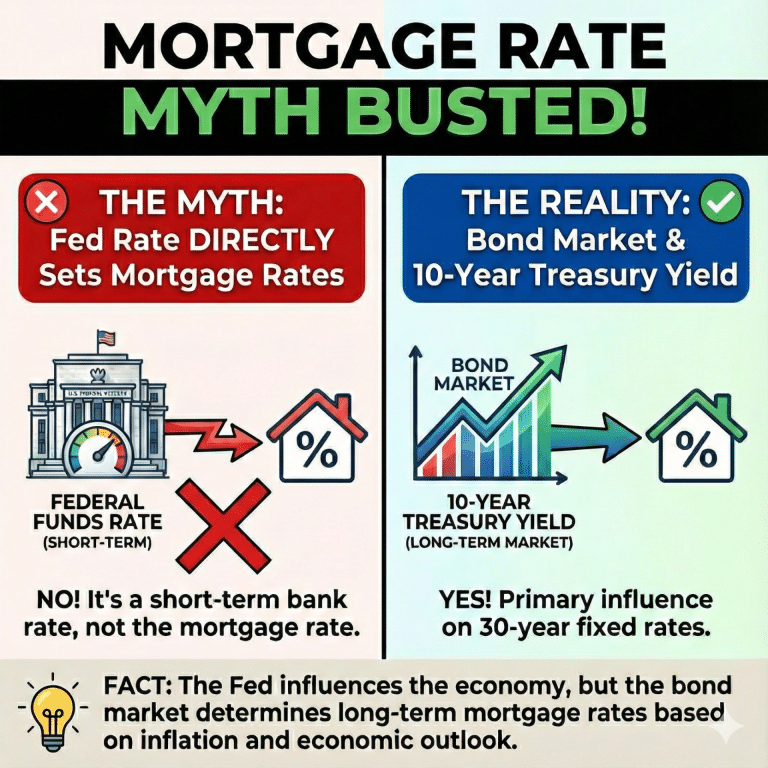
Today, with the help of this handy infographic, we’re going to bust that myth and explain what really moves the needle on your monthly payment in plain English.

The Visual Breakdown: Myth vs. Reality

Let’s look at the graphic below. It perfectly illustrates the difference between what most people think happens versus what actually happens.

Mortgage Rae Myth

The Myth (The Red Side): The Fed's Direct Line

Look at the left side of the image. The common belief is that when the Federal Reserve (the building on the left) changes its rate, it sends a direct signal to the housing market, instantly changing the percentage rate on a home loan.

Why this is false:

The rate the Fed controls is called the Federal Funds Rate. This is a very short-term rate. It’s basically the interest rate banks charge each other to lend money overnight.

Think of it like this: If you needed to borrow $20 from a friend until tomorrow, the “interest” would be very low because the risk is low and the time is short. That’s the world the Fed operates in.

While a change in the Fed Funds Rate does affect things like credit card interest and car loans pretty quickly, it does not directly set the price of a 30-year mortgage.

The Reality (The Blue Side): The Bond Market acts as the Boss

Now, look at the right side of the image. This is how the financial world actually works.

A mortgage is a long-term commitment—usually 15 or 30 years. Because it’s a long-term loan, its interest rate is tied to long-term investment benchmarks.

The biggest benchmark for fixed-rate mortgages is the 10-Year Treasury Yield. This is the return investors get for buying U.S. government bonds that mature in ten years.

Why the 10-Year Treasury matters:

Investors who provide the money for mortgages want a safe, predictable return. They look at the 10-Year Treasury bond as the “risk-free” baseline. If they are going to lend money for a mortgage instead of buying a government bond, they demand a higher interest rate to make it worth the extra risk.

Therefore, mortgage rates almost always track the 10-Year Treasury yield up and down. You can see this clearly in historical data showing the correlation between the two. If the yield on the 10-year bond goes up, mortgage rates go up. If it goes down, mortgage rates go down.

The Connection: It’s All About Inflation
So, if the Fed doesn’t set mortgage rates, do they matter at all? Yes, absolutely. But their influence is indirect.

As the bottom “FACT” section of our infographic states: The Fed influences the economy, but the bond market determines long-term mortgage rates based on inflation and economic outlook.

Here is the simplest way to understand the relationship:

1. Inflation is the enemy of low rates. Lenders hate inflation because it eats away at the future value of the money they lend you. If investors fear inflation is rising, they will demand higher yields on Treasury bonds, which pushes mortgage rates up.

2. The Fed fights inflation. When the Fed raises its short-term rates, it’s trying to cool down the economy to stop inflation.

3. The Bond Market reacts. If the bond market believes the Fed is successfully fighting inflation, Treasury yields will often drop, bringing mortgage rates down with them—even if the Fed is currently hiking its own short-term rates!


What This Means for You as a Homebuyer

Knowing that the bond market is the real driver of mortgage rates, here is our advice at MarketVision Real Estate:

1. Stop trying to “time the Fed.” Don’t make major life decisions based on a news headline about an upcoming Fed meeting. The bond market has usually already “priced in” whatever the Fed is about to do days or weeks in advance.

2. Focus on affordability, not just the rate. The rate is important, but so is home price, your down payment, and your monthly budget.

3. Talk to a pro. The bond market changes every single day. You can check the current 10-Year Treasury yield yourself, but interpreting what it means for your loan requires expertise.

If you are confused about the current rate environment and want to know what you can truly afford in today’s market, reach out to the team at MarketVision Real Estate. We can connect you with trusted local lenders who can cut through the noise and give you the real numbers.

Jacob Hartley, (2025, December12). Fed Rate vs Mortgage Rates: Busting the Real Estate Myth. https://www.marketvisionre.com/

If you live in the United States, chances are you probably have a relationship with a GSE, government-sponsored enterprise. A GSE is sort of a government agency. Meaning that it is a privately held agency established by Congress. Whenever you try to understand how these entities work, the jargon can be difficult to understand. Making something simple seem overly complicated. In this post, we hope to simplify what a government-sponsored enterprise is and how they work.

What Does GSE Stand For?

“GSE stands for government-sponsored enterprise. A GSE provides financial services to the public for various things, particularly mortgages, through capital market liquidity. Now, to give it to you in plain English, a government-sponsored enterprise is a company that’s supported by the government but run privately to help improve specific areas of the U.S. economy. They do this by guaranteeing to purchase a specific type and number of loans and then selling them as mortgage-backed securities to investors in the secondary market to boost capital flow in the real estate market. Think of it like this: if a lender only had enough money to fund 30 mortgages at $100,000 that all had a 30-year term, they would have to wait 30 years before they could offer additional $100,000 mortgages. To avoid this issue, a GSE purchases loans from third-party lenders, therefore giving them more cash flow to lend.”


How Do GSE Mortgage Loans Work?

“GSEs like Fannie Mae and Freddie Mac don’t actually issue you a mortgage loan directly. Instead, they provide third-party loans and purchasing guarantees in the secondary market, which provides lenders with more flexibility and money to lend. It also makes it easier for the borrower to get approved because loans that are guaranteed by Fannie Mae and Freddie Mac usually have a lower down payment requirement, a lower credit score requirement and better interest rates. GSEs, therefore, increase the number of homes purchased and increase money flowing in the real estate industry.” This post’s main focus is on mortgage GSEs, but they also assist other industries as well like student loans through the U.S. Department of Education.

List Of Government-Sponsored Enterprises

Mortgage GSE’s

  • Federal Home Loan Banks. Founded in 1932 and made up of various banks and lenders, the Federal Home Loan Banks were the first mortgage-based GSEs. The Federal Home Loan Banks system is the only GSE that can directly issue mortgages.
  • Federal National Mortgage Association (FNMA or Fannie Mae). This GSE was founded in 1938 and provides mortgage funding by buying them from large commercial banks to sell to investors.
  • Federal Home Loan Mortgage Corporation (FHLMC or Freddie Mac). This GSE was founded in 1970 and is similar to Fannie Mae, except that it purchases mortgages from smaller banks and lenders.


Agricultural GSEs

  • Farm Credit System. The first GSE, created in 1916, provided credit for farmers and ranchers to support the country’s agriculture. It is made up of a network of cooperating lenders and associations.
  • Federal Agricultural Mortgage Corporation (FAMC or Farmer Mac). This GSE was established by Congress in 1987 and guarantees repayment to agricultural investors.


GSEs help make home ownership possible. Without them in the mortgage space, it would be really hard to buy a home, especially if you had a low income or a low credit score. Because of GSEs and mortgage investors, the U.S. economy has a mortgage market that has access to liquidity and stability at all times.

Source:https://www.rocketmortgage.com/learn/government-sponsored-enterprise

Facebook
Twitter
LinkedIn

Let Us Know How We Can Help...

What did you need assitance with?

What is a Fortified Home and How Does it Help Me?

“FORTIFIED is a better way to build, re-roof, or retrofit your home to protect against severe weather. It is a voluntary construction and re-roofing program designed to strengthen homes and commercial buildings against specific types of severe weather such as high winds, hail, hurricanes and even tornadoes. The program provides:

  • Free access to construction standards, which are based on more than 20 years of scientific research and real-world testing by the Insurance Institute for Business & Home Safety (IBHS).
  • A network of contractors trained to provide the right upgrades to protect your home from the type of severe weather events it faces each year.
  • Third-party verification that the upgraded construction materials and installation methods used on your home meet the standards required for a FORTIFIED designation certificate.”

There are two FORTIFIED programs, both with specific requirements beyond what’s required by most building codes, that provide protection from storms as strong as a Category 3 hurricane or an EF-2 tornado.

  • FORTIFIED Home for homeowners
  • FORTIFIED Commercial for commercial property owners
 

FORTIFIED Home offers three ways to strengthen and protect your new or existing home.

  • FORTIFIED ROOF- This is for roofing or re-roofing. Focuses on strengthening the roof to help keep it attached to your home during high winds and keep water out if roof covering (such as shingles or tiles) get blown off in a storm.
  • FORTIFIED SILVER- This is best for existing homes. Builds on the requirements of FORTIFIED Roof to also help protect vulnerable areas such as windows and doors as well as attached structures such as carports.
  • FORTIFIED GOLD- This is best for new homes. Builds on requirements of FORTIFIED Roof and FORTIFIED Silver to provide the best protection available against severe weather.

It doesn’t take a hurricane or tornado to cause major damage to your home. In fact, storm winds as low as 50 mph can damage your roof and allow water to enter your home. To protect against this type of damage, make sure that the home you are purchasing has a FORTIFIED designation certificate. The upgraded construction materials and installation methods used on the home will better protect your home and everything inside.
Fortified Home

What are the benefits of a Fortified Home?

  • FORTIFIED homes are stronger against severe weather and suffer less damage.
  • The FORTIFIED method involves an inspection and verification process ensuring your home is built or re-roofed correctly.
  • A FORTIFIED designation may qualify you for annual wind mitigation credit that could lower your insurance premium. Check with your insurance agent for specific policy requirements and potential wind mitigation credits in your area.
  • Alabama Resident FORTIFIED-Specific Incentives

    • Discounts – Most insurers in Alabama offer significant discounts for homes meeting the FORTIFIED standards. Savings can range from 20% to 55% of the wind portion of your homeowners premium (depending on the level of FORTIFIED and whether your home is on the coast or more inland).
    • Endorsements – For homes without a FORTIFIED designation, most Alabama insurers offer a FORTIFIED endorsement to homeowners policies. When the roof of a home with the endorsement is damaged and being replaced by the insurance company, it will pay additional funds to help offset the cost of upgrading to a FORTIFIED Roof.
    • Grant program – When funded, Strengthen Alabama Homes provides grants up to $10,000 to owners of existing homes when they re-roof to the FORTIFIED Roof standard. There are no income restrictions for this grant program, and it is open to anyone with a primary residence in Alabama.
    • Tax Deduction – Alabama residents may deduct from gross income the lesser of 50 percent of the cost or $3,000 to retrofit or upgrade their home to resist wind or flood damage, and the FORTIFIED standards can qualify. Consult a tax advisor for more information.

Source: https://fortifiedhome.org/about/, https://fortifiedhome.org/incentives/

Facebook
Twitter
LinkedIn

Let Us Know How We Can Help...

What did you need assitance with?

What is an Appraisal?

An appraisal is the estimation of a home’s current market value, or more broadly defined as an opinion of value that is used for real-estate-related financial transactions. Appraisals are required by a state-licensed or certified appraiser for most transactions above $250,000. An appraiser’s report will typically include the type of property inspection, approaches to value required, and any lender-specific requirements. Appraisals are required by mortgage lenders to be sure that the money they are lending to a new homeowner or a current homeowner is a fair amount for the home. The lenders want to be sure that the buyers are not overpaying for the property. If the borrower stops making payments on the home and the lender needs to sell it, the lender wants to be sure it can recuperate the amount owed on the loan. The value of the home will be calculated by examining the current local housing market and the comparable properties that have recently sold. It will also include the features of the home, square footage, and a number of bedrooms and bathrooms. The appraiser will also look at the overall condition of the home. If there is maintenance or repairs that will need to be completed, the appraiser will note these. The appraiser will then complete the appraisal report on a standard required form. An appraisal can potentially break the deal. If the selling price and the appraisal are not comparable, the lender will not approve the deal without additional funds from the buyer to cover the appraisal gap. An appraisal is an important part of the home buying process because it assures the lender the property has adequate collateral to make the loan. It is also important to note that not all mortgage loans have the same appraisal requirements or guidelines. Given the specific mortgage and lender guidelines and overall economic conditions, an appraisal is not always a concrete determining factor of market value. For instance, in economic environments where real estate values rise rapidly, appraisal values can lag cash sale transactions. 

When dealing with Freddie Mae and Fannie Mac, additional criteria for not only the certification of the appraisers but how they perform the appraisal are outlined by each entity. Fannie Mae and Freddie Mac are federally backed home mortgage companies created by the United States Congress. They provide liquidity (ready access to funds on reasonable terms) to the thousands of banks, savings and loans, and mortgage companies that make loans to finance housing.

“Freddie Mac requires that the Seller obtain an appraisal report that accurately reflects the market value, condition, and marketability of the property. The Seller is responsible for compliance with the Appraiser Independence Requirements (AIR), the selection of the appraiser, the appraiser’s use of the appropriate Freddie Mac appraisal report forms, compliance with the Uniform Appraisal Dataset (UAD), and successful submission of the appraisal report to the Uniform Collateral Data Portal® (UCDP®), all as specified in more detail in this chapter. “

“Fannie Mae requires a lender (or its authorized agent) to use appraisers or supervisory appraisers that are state-licensed or state-certified (in accordance with the provisions of Title XI of the Financial Institutions Reform, Recovery and Enforcement Act of 1989 and all applicable state laws). The lender (or its authorized agent) must document that the appraisers it uses are licensed or certified as appropriate under the applicable state law. The lender must ensure that the state license or state certification is active as of the effective date of the appraisal report. The appraiser must note his or her license or certification number on the individual appraisal report forms, in compliance with the Uniform Appraisal Dataset Specification, Appendix D: Field-Specific Standardization Requirements.”

In summary, appraisals determine a property’s worth and provide an unbiased estimate of value. Appraisers can be hired by the lender or seller, or even sometimes the buyer. There are more requirements for not only the appraiser but the type of report that they complete based on where your mortgage is from and who is backing it. For more information check out the websites below.

What is Market Value?

As defined by HUD, Market Value refers to the most probable price which a property should bring in a competitive and open market under all conditions requisite to a fair sale, the buyer and seller, each acting prudently, knowledgeably and assuming the price is not affected by undue stimulus. Implicit in this definition is the consummation of a sale as of a specified date and the passing of title from seller to buyer under conditions whereby: buyer and seller are typically motivated; both parties are well informed or well advised, and each acting in what they consider their own best interest; a reasonable time is allowed for exposure in the open market; payment is made in terms of cash in U. S. dollars or in terms of financial arrangements comparable thereto; and the price represents the normal consideration for the Property sold unaffected by special or creative financing or Sales Concessions granted by anyone associated with the sale.

Adjustments to the comparables must be made for special or creative financing or Sales Concessions. No adjustments are necessary for those costs, which are normally paid by sellers as a result of tradition or law in a market area; these costs are readily identifiable since the seller pays these costs in virtually all sales transactions. Special or creative financing adjustments can be made to the comparable Property by comparisons to financing terms offered by a third-party institutional lender that is not already involved in the Property or transaction. Any adjustment should not be calculated on a mechanical dollar-for-dollar cost of the financing or concession but the dollar amount of any adjustment should approximate the market’s reaction to the financing or concessions based on the Appraiser’s judgment.

Facebook
Twitter
LinkedIn

Let Us Know How We Can Help...

What did you need assitance with?

Welcome to WordPress. This is your first post. Edit or delete it, then start writing!

Schedule A Tour

Thank You!

A MarketVision representative will contact you within 24 hours to present you with their offer!